Hello everyone, today in Chemistry Mrs. Mandarino stamped our homework. Once again we did not have a chance to switch seats because we went straight to our lab. First Mrs. Mandarino explained the titration 3 lab and told us how to do everything. We went to go do the lab and it did not go smoothly for our group. The purpose of this lab was to apply titration to determine the precise molarity of an NaOH solution using a known solid acid. After we found all of our data we recorded it and started the post lab questions but we ran out of time. Our homework was to finish the lab.
-Simone
Friday, April 15, 2011

Thursday, April 14, 2011
Titration Station
Hello friends and family, it's time for the blog you've all been waiting for. There isn't a Cubs game tonight so I can do my homework.
Before I teach you how to dougie, I'm going to teach how to do Titration. Ok here's some examples of the problems we have been doing in class over the pass couple of days.
MaVa=MbVb
Acids and Bases my friends
Ph 0-14 1-6 acid 7 neutral 8-14 base
First, complete and balance your equation.
HBr + Ca(OH)2 -------> CaBr2 + 2H2O
A 50 mL of HBr is titrated to an end point with 24 mL of 1.5 M NaOH. What is the concentration of the HBr?
Ma(50mL)=(1.5M)(24mL)
Ma= .72M
Let's take it to the next level shall we?
First here's some notes I took.
1 x 10^-5 Predicted Ph=5 Acid
pH=6 pOH= 8
pH= 3 pOH=11
Alright so I hope that helps everyone, the homework was to finish the box on page 4. Also on page 5 do all the problems except 2 d. and 3 a.
Μαντώ, είστε τα γόνατα μελισσών. Μακάρι να μπορούσαμε να γίνουμε φίλοι και πάλι,
συγγνώμη για όλα λάθος κατορθώματα μου. Χαιρετισμοί
συγγνώμη για όλα λάθος κατορθώματα μου. Χαιρετισμοί
Tuesday, February 22, 2011
Molarity
The Agenda
4.) H2CO3(aq) + 2KOH(aq) ---> 2H2O + K2CO3(s)
5.) CdBr2(aq) + Na2S(aq) ---> CdS(s) + 2NaBr(aq)
6.) 2NaOH(aq) +Ba(NO3)2(aq) ---> 2NaNO3(aq) + Ba(OH)2(aq)
Molarity
M =moles of solute
liters of solution
Its like stoich but there's Liters in it. There are some stuff that Mrs. Mandarino has not covered yet,
she just talked about the equation of Molarity and answered some of the questions in Molarity sheet 1 and 2
Molarity sheet 1
1.)What is the molar mass of the following compounds? Write dissociation reactions for each of them.
(so basically, you just have to find the molar mass- easy)
a.) NaNO3 (1 x 14.01g) + (1 x 22.99g) + (3 x 16.00g) = 85g
b.) CaCl2 (1 x 40.08) + (2 x 35.45g) = 110.48g
2.)Calculate the number of moles of the following (yeah, step by step)
a.) 25g of NaNO3 x 1mol NaNO3 = 294 mol NaNO3
85gNaNO3
b.) 200g of CaCl2 x 1mol CaCl2 =1.8 mol CaCl2
110.98g CaCl2
3.) Calculate the molarity of the following solutions. (You will use the equation in here- new stuff)
a.) 0.25 liters of solution contains 0.0346 moles of NaNO3
M= 0.0346 mol = .1384 mol/L or .138 M
0.250 L
b.) 7.54 liters of solution that contains 0.75 moles of CaCl2
M= 0.75 mol = 15 M
7.54 L
c.) 100.0 ml of solution that contains 1.5 moles of C6H12O6 (Pro tip: watch out for the measurements, we
need liters not milliliters, so it's .1L of solution. Also C6H12O6 is Glucose)
M= 1.5 mol = 15 M
.1 L
d.) 560 ml (.56L) of solution that contains 0.025 moles of AgNO3
M= .02 mol = .036 M
.56 L
Molarity sheet 2
4.) Calculate the molarity of the following solutions.
a.) 1.5 liters of a solution that contains 55.5 g of NaNO3
55.5g NaNO3 x 1 mol NaNO3 = .653 mol NaNO3 (because we want the = .44 M
85.0g NaNO3 1.50L molarity of the solution)
5.) Calculate the moles of solute in the following solution.
a.) 0.2 liters of 0.125 M C6H12O6
.2 L x .125 mol = .025 mol C6H12O6
1L
6.) Calculate the volume of the following solutions.
a.) 0.5 moles of CaCl2 makes of a 0.667 M solution
0.5 mol x L =.750 L CaCl2
.667mol
Well that's all folks. Remember to finish the other questions in Molarity sheet 1 and 2 for homework tomorrow. Furthermore, the webassign are posted and ready to be answered.
- Stamp the homework (4-6 in Reaction solubility and the lab)
- Check homework
- Start Molarity
4.) H2CO3(aq) + 2KOH(aq) ---> 2H2O + K2CO3(s)
5.) CdBr2(aq) + Na2S(aq) ---> CdS(s) + 2NaBr(aq)
6.) 2NaOH(aq) +Ba(NO3)2(aq) ---> 2NaNO3(aq) + Ba(OH)2(aq)
Molarity
M =moles of solute
liters of solution
Its like stoich but there's Liters in it. There are some stuff that Mrs. Mandarino has not covered yet,
she just talked about the equation of Molarity and answered some of the questions in Molarity sheet 1 and 2
Molarity sheet 1
1.)What is the molar mass of the following compounds? Write dissociation reactions for each of them.
(so basically, you just have to find the molar mass- easy)
a.) NaNO3 (1 x 14.01g) + (1 x 22.99g) + (3 x 16.00g) = 85g
b.) CaCl2 (1 x 40.08) + (2 x 35.45g) = 110.48g
2.)Calculate the number of moles of the following (yeah, step by step)
a.) 25g of NaNO3 x 1mol NaNO3 = 294 mol NaNO3
85gNaNO3
b.) 200g of CaCl2 x 1mol CaCl2 =1.8 mol CaCl2
110.98g CaCl2
3.) Calculate the molarity of the following solutions. (You will use the equation in here- new stuff)
a.) 0.25 liters of solution contains 0.0346 moles of NaNO3
M= 0.0346 mol = .1384 mol/L or .138 M
0.250 L
b.) 7.54 liters of solution that contains 0.75 moles of CaCl2
M= 0.75 mol = 15 M
7.54 L
c.) 100.0 ml of solution that contains 1.5 moles of C6H12O6 (Pro tip: watch out for the measurements, we
need liters not milliliters, so it's .1L of solution. Also C6H12O6 is Glucose)
M= 1.5 mol = 15 M
.1 L
d.) 560 ml (.56L) of solution that contains 0.025 moles of AgNO3
M= .02 mol = .036 M
.56 L
Molarity sheet 2
4.) Calculate the molarity of the following solutions.
a.) 1.5 liters of a solution that contains 55.5 g of NaNO3
55.5g NaNO3 x 1 mol NaNO3 = .653 mol NaNO3 (because we want the = .44 M
85.0g NaNO3 1.50L molarity of the solution)
5.) Calculate the moles of solute in the following solution.
a.) 0.2 liters of 0.125 M C6H12O6
.2 L x .125 mol = .025 mol C6H12O6
1L
6.) Calculate the volume of the following solutions.
a.) 0.5 moles of CaCl2 makes of a 0.667 M solution
0.5 mol x L =.750 L CaCl2
.667mol
Well that's all folks. Remember to finish the other questions in Molarity sheet 1 and 2 for homework tomorrow. Furthermore, the webassign are posted and ready to be answered.
Friday, February 18, 2011
Solutions
Since Dan has failed us twice, I am sharing 8th period's scribe:
Yesterday in class we finished our Mixtures Lab. We took each of the four mixtures and completed the evaporation test and went on to the filtrate lab. To fill out the back sheet of the paper, we can use the notes we took in class on Wednesday. If you want to check if you got the correct results, they are on moodle.
We also learned about solubility and dissolving. We learned that there are two categories of solutions: the solutes and the solvents.
Solutes:
-What is being dissolved
-Usually smaller amount
Solvents:
-What deos the dissolving
-Usually the greater amount
Ionic Compounds: When they are dissolved in water they split into ions (dissociation)
Covalent Compounds: When they are dissolved in water they do not split
*When the compounds are dissolved in water you change the subscrips to (aq), which means in water*
The homework is to finish the Mixtures Lab.
[The notes Mrs. Mandarino gave us in class are on moodle, in the notes section.
If you missed ChemDay, the make up assignment can be found in the homework log section on moodle.]
Yesterday in class we finished our Mixtures Lab. We took each of the four mixtures and completed the evaporation test and went on to the filtrate lab. To fill out the back sheet of the paper, we can use the notes we took in class on Wednesday. If you want to check if you got the correct results, they are on moodle.
We also learned about solubility and dissolving. We learned that there are two categories of solutions: the solutes and the solvents.
Solutes:
-What is being dissolved
-Usually smaller amount
Solvents:
-What deos the dissolving
-Usually the greater amount
Ionic Compounds: When they are dissolved in water they split into ions (dissociation)
Covalent Compounds: When they are dissolved in water they do not split
*When the compounds are dissolved in water you change the subscrips to (aq), which means in water*
The homework is to finish the Mixtures Lab.
[The notes Mrs. Mandarino gave us in class are on moodle, in the notes section.
If you missed ChemDay, the make up assignment can be found in the homework log section on moodle.]
Tuesday, February 8, 2011
Limiting Reactants
Limiting Reactant Strategy
If a problem mentions amounts of more than one reactant, its probably a limiting reactant problem.
For Example:
Fe + S à FeS
If a problem mentions amounts of more than one reactant, its probably a limiting reactant problem.
- Go from each reactant to amount of product (grams of each reactant to grams of product)
- The reactant that produces the lower amount of predicted product is the limiting reactant. This amount of product is also the amount that can be produced.
- The other reactant is your excess reactant.
For Example:
Fe + S à FeS
If I have 28g of Iron (56 g/mol) and 24g of Sulfur (32 g/mol), how much FeS can be made and what is the limiting reactant?
28 g Fe x 1 mol Fe x 1 mol FeS x 87.92g FeS = 44 g FeS
55.85 g Fe 1 mol Fe 1 mol FeS
24 g S x 1 mol S x 1 mol FeS x 87.92g FeS = 66 g FeS
32.07 g S 1 mol S 1 mol FeS
Fe is the Limiting reactant because it runs out first and produces less FeS.
Tuesday, February 1, 2011
Stoichiometry
Today in Mando's fifth period chem class we did a multitude of things. we went over the homework which was pages fifteen and sixteen. After that we spent the rest of the class taking our Stoich quiz, you must score a one-hundred percent on at least one of the Stoich quizes to take the unit test. the homework for tonight is pages 17 and 18.
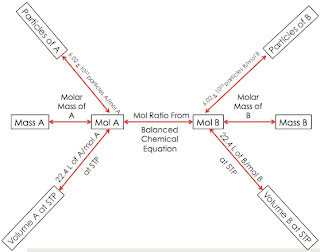
Also see the cheat sheet in the Unit 8 Stoich notes on Moodle!!!
Jack H.

Also see the cheat sheet in the Unit 8 Stoich notes on Moodle!!!
Jack H.
Tuesday, January 25, 2011
Moles and Molar Mass
Today in chemistry, we picked up additional worksheets that went along with Unit 8. We then worked on pages 7 and 8 to refresh our minds on ionic and covalent formulas. Remember that an ionic compound consists of a metal and a non-metal. Covalent compounds consists of only non-metals. Writing the name of the formula depends on what compound it is. On page 8 of the review, we started to determine the molecular mass of compounds. When given a compound, you must write out the formula first. Then, count how many atoms are in the first element and multiply that number by the element's atomic mass. The atomic mass can be found on the periodic table. Do the same thing with the second element in the formula. Then, add these two products together and the sum you get is the molar mass. An example would be like this:
Compound given: carbon dioxide
Formula: CO2
There is one C so you multiply 1 by the atomic mass. Carbon's atomic mass is 12.01 grams. 1 x 12.01 g. Looking at oxygen, it has two atoms. The atomic mass of Oxygen is 16.00 grams. 2 x 16.00 g. Then you add these two products. The answer is 44.01. The equation should look like this: (1 x 12.01 g) + (2 x 16.00 g) = 44.01 grams.
The next thing we did was how to calculate the number of moles. You had to apply your knowledge of molar mass to figure out how to do this. It is like unit conversion. An example would be like this: 50 g of carbon dioxide.
You should write down the number that is given to you so you should write out 50 g of CO2. You need to multiply this by something. Since we want to figure out the number of moles in a compound, we would write 1 mole of CO2 at the top of the dividing line. At the bottom would be the molar mass of CO2 and the unit should be g of CO2 since we want to cancel this out. You then calculate all this and the answer should come out to be 1.14 moles of CO2. The equation should look like this:
50 g of CO2 x 1 mole of CO2/44.01 g of CO2 = 1.14 moles of CO2.
After completing pages 7 and 8, we started on page 1. It pretty much had the same concept on what we did on page 8. Near the end of class, Mrs. Mandarino stamped the labs.
Homework is to complete worksheets pg 1 and 2!
Compound given: carbon dioxide
Formula: CO2
There is one C so you multiply 1 by the atomic mass. Carbon's atomic mass is 12.01 grams. 1 x 12.01 g. Looking at oxygen, it has two atoms. The atomic mass of Oxygen is 16.00 grams. 2 x 16.00 g. Then you add these two products. The answer is 44.01. The equation should look like this: (1 x 12.01 g) + (2 x 16.00 g) = 44.01 grams.
The next thing we did was how to calculate the number of moles. You had to apply your knowledge of molar mass to figure out how to do this. It is like unit conversion. An example would be like this: 50 g of carbon dioxide.
You should write down the number that is given to you so you should write out 50 g of CO2. You need to multiply this by something. Since we want to figure out the number of moles in a compound, we would write 1 mole of CO2 at the top of the dividing line. At the bottom would be the molar mass of CO2 and the unit should be g of CO2 since we want to cancel this out. You then calculate all this and the answer should come out to be 1.14 moles of CO2. The equation should look like this:
50 g of CO2 x 1 mole of CO2/44.01 g of CO2 = 1.14 moles of CO2.
After completing pages 7 and 8, we started on page 1. It pretty much had the same concept on what we did on page 8. Near the end of class, Mrs. Mandarino stamped the labs.
Homework is to complete worksheets pg 1 and 2!
Sunday, January 9, 2011
January 7, 2011
In Mrs. M class, Friday we did the usual getting the homework stamped and looked over it. Following it we got off track talking about other things. In doing so we made it impossible to go over all of the neccessary information on the test. But we did go over half lives a bit more along with chain reactions and nucleor reactors. If you forgot, half-lives are the length of time it takes for a substance to decay over a period of time. Every set of years half of the substance dissapears until stable or gone. Chain reactions occur during Fission not fusion. Fission is the splitting of atoms and fusion is the combining of them. Fission occurs when a neutron hits a bigger nucleus causing large amounts of energy to be released in different elements and more nuetrons. More can be found on page 15 of the worksheets. Nuclear Reactors are divided into three parts. A.) Control rods absorb neutrons to slow down chain reactions B)Fuel Rods contain 3 percent of U-235 C.) Moderator slows down neutrons so they can be absorbed by the control rods. Again since we talked during class we ran out of time and did not cover Ionizing Radiation or Radon and we do not have to learn it for the test. Remember the test is MONDAY!
Happy Studies.
M.J.
Happy Studies.
M.J.
Tuesday, January 4, 2011
January 4, 2011
Today in chemistry, Mrs. M asked for us to bring our journals to get them stamped for the homework of the previous night which was page 3. After stamping we went over page 3 and checked all of our answers. Then we moved onto page 6 and learned about isotopes. Isotopes are atoms that have the same number of protons but have a different number of neutrons. Then we started pages 5 and 7 for practice to get familiar with how to identify: the isotope symbol, the name of the isotope, the atomic number, the mass number, number of electrons (in a neutral atom), the number of protons, and the number of neutrons.
- To find the isotope symbol you have to put the mass number on top of number of protons the element has, then put the element's symbol after that.
After finishing with page 7 we moved onto page 10 and learned about "half-lives." A half-life is the period of time it takes for a substance undergoing decay to decrease by half. We then practiced using half-lives to figure out a problem. Then class ended and Mrs. M assigned us page 9 and page 10 #3 for homework.
P.S. HAPPY NEW YEAR ;)
- Taso K.
Wednesday, December 15, 2010
Single and Double Replacement Labs


Alright, so today in class we went over the double and single replacement labs that we did with Mr. Tucker Monday. If you missed it you should have the papers in your journal but if not, there are copies on the back counter of the classroom. Tonight our homework is to review the quiz that we took on Friday, and correct any mistakes that we might have made. Above I've posted pictures from the board and those are the answers from the chemical reactions lab that we went over in class today.For a review, single reactions replace a single uncombined element replaces another in a compound. Two reactants yield two products.
 width="300">
In a double replacement reaction, parts of two compounds switch places to form two new compounds.
 doublereplaceimage" align="baseline" height="28" width="378">
Also, don't forget to balance!
By Corey L.
Thursday, December 9, 2010
scribe post December 9
Today in Chemistry Mrs. M told us to not talk and be obnoxious when she is talking. Then she told us she got the presents for the little kids, after that we went over page 18 in our journal which was our homework, and the class seemed to understand it very well. After page 18 we went onto page 19, and learned about predicting products, using the reactions, synthesis, decomposition, single replacement, double replacement, and combustion. To predict the product you first have to find what type of reaction it is, then you have to create the product by the different reaction rules, and finally when you have your product you simply balance the equation. We did numerous problems to practice our new topic. After that Mrs. M assigned page 20 for homework, and she gave us time to start it. All in all it was a blast!
By Simone K
By Simone K
Monday, November 22, 2010
Scride Post Nov 22 Per. 5
Monday November 22, 2010
HomeworkWe started chemistry class today by picking up Polarity Olympics: The Games sheets and getting Polarity of Molecules 2 (pg 26) stamped. Before starting the lab we learned that polar molecules are molecules that have both a positive and negative side like water. Also, intermolecular forces are when the attraction is weaker than the bonds that hold it together, but is strong enough to affect the properties of water. We then started the Polarity Olympics lab which had two parts, The Trials and The Games.
The Trials:
Trial 1- The Penny Pile-on: In this trial each liquid will try to create as large a pile on a penny as possible.
Trial 2- The Capillary Tube Climb: In this trial each liquid will try to climb as high as possible in a vertical glass tube.
Trial 3- The Marker Clean Up: In this trial each liquid will try to clean two types of marker from glass.
The Games:
Part 1- Solubility: In this part we each liquid was added to water to see if they would mix.
Part 2- Volatility and Surface Tension: In this part each liquid was ranked in its ability to spread on a table and evaporate.
Finish Polarity Olympics Lab
Webassigns
Study for Lab Test
Thursday, November 18, 2010
Thursday November 18
Yesterday we started the class by picking up pages 21-25 plus another sheet. After picking up the pages, we all sat down for class. Some of the people did not finish building their molecules from two days ago so we then took the time to do that. Mrs. M went around stamping like crazy. After we finished the lab, we did page 20. When we completed 20 we started polar and nonpolar covalent bonding. One of the sheets we got was a periodic tables with a bunch of numbers with the different elements. We got half way through page 21. The rest of it was for homework
Today we started class by picking up 4 pages. After we all settled down we started on the different types of bonds. There are three kinds of bonds; Polar covalent, non-polar covalent and ionic. A polar bond is when one electron has a stronger electronegativity than the other in the bond and holds the electron closer to it's nucleus. Non-polar covalent bonding is when the electron being shared is evenly distributed between the two atoms. An ionic bond is when the pull from one atom is so strong that it rips the electron from an other atom. To find out what kind of bond the molecule has you take the electronegativity of the two atoms and subtract the bigger one from the smaller one. If the difference is less than or equal to 0.4 the bond is non-polar covalent. If the difference is 1.7 or higher the bond is ionic. Anything inbetween those is polar covalent. After learning this we went through and did pages 22-25.
Homework: Page 26 and webassigns & chemthink if you have not finished them
Today we started class by picking up 4 pages. After we all settled down we started on the different types of bonds. There are three kinds of bonds; Polar covalent, non-polar covalent and ionic. A polar bond is when one electron has a stronger electronegativity than the other in the bond and holds the electron closer to it's nucleus. Non-polar covalent bonding is when the electron being shared is evenly distributed between the two atoms. An ionic bond is when the pull from one atom is so strong that it rips the electron from an other atom. To find out what kind of bond the molecule has you take the electronegativity of the two atoms and subtract the bigger one from the smaller one. If the difference is less than or equal to 0.4 the bond is non-polar covalent. If the difference is 1.7 or higher the bond is ionic. Anything inbetween those is polar covalent. After learning this we went through and did pages 22-25.
Homework: Page 26 and webassigns & chemthink if you have not finished them
Tuesday, November 16, 2010
The 16th of November, 2010
Today, in Chemistry 163 Period 5, we began class by getting our previous homework checked (pages 18 and 19, a.k.a. Molecular Shapes 2&3) and stamped. Mrs. M asked us if we needed explanation on anything, and we did a few examples from the pages. (For answers, please refer to the photos...sorry if quality is bad. Remember: you do have the VSEPR sheet to refer to for more answers!)
page 18: page 19:

page 19: After that, we continued on to our next activity: Molecular
Geometry - the three-dimensional arrangement of the atoms that constitute a molecule. We used the packet that consisted of rows of molecules and columns of the Lewis Structure, # of Atoms on central (refer to the gold VSEPR sheet for the #/#/# answers), # of Lone pairs, Shape, 3D Picture, and Stamp (from Mrs. M).
ex.
We used wooden spheres, sticks, and springs to create 3D molecules during class. If you did not finish or get them all checked, please finish the work tonight for homework, and we will have time in class tomorrow to finish creating them. Enjoy the late arrival tomorrow! But do your homework!
HOMEWORK:
- finish Molecular Geometry packet
- ^remember to answer the questions on the 2nd page!
- ENJOY THE LATE ARRIVAL
Kiva T.
Tuesday, November 9, 2010
Lewis Structures – November 9th 2010
When we first walked into class today, we picked up pages 9-15. Then, Mrs. M stamped our page #6 (the homework assigned yesterday). Once everyone was settled again, we went over all the answers to page 6. These answers can be found on Moodle!
WARNING!: Tomorrow is the beginning of a streak of 6 quizzes! The quiz tomorrow will be seeing if you can tell the difference between and Ionic and Covalent compound, and if you can name each of them.
| Ionic | Makes compounds | Transfers electrons | Made with metals and nonmetals | Positive and negative charges | Weak bonds!! | Ex: NaCl |
| Covalent | Makes molecules | Shares electrons to be noble | Made of ONLY nonmetals | Neutral charges | Strong bonds!!! | Ex: H₂O |
Next, we did pages 7, 8, 10, & 11. You may read page 9 at your own leisure, as it only describes how to create a Lewis structure. Mrs. M knows 2 ways to figure out how to create Lewis Structures. She began to teach us the first way, (described on page 9) and the taught us “her way”. On our periodic tables, we added the amount of valance electrons. Under the first family we put 1, indicating there is 1 valance electron on all the above atoms. 2nd family we put 2, 13th we put 3, 14th we put 4, 15th we put 5, 16th we put 6, 17th we put 7, and 18th we put 8, indicating that these atoms are stable.
GUIDELINES OF LEWIS STRUCTUES:
-Consult the molecular formula and sum up all the valence electrons from the separate atoms.
- Choose central atom
- The first element in the compound becomes the central atom (excluding hydrogen).
-Insert pairs of electrons between all pairs of atoms that are to be bonded together
-Place any remaining electrons on peripheral atoms as unshared pairs, starting with the most electronegative such atom.
Mrs. M began teaching us “her way” of drawing Lewis Structures. This method includes NHS (Needed; Have; and Shared electrons.)
First you take the amount of atoms in the compound (excluding Hydrogen) and multiply it by 8 electrons which results in the amount of electrons NEEDED to have a stable compound.
Then, you fine the amount of valance electrons you have. Look at the charge of the atom that we listed at the bottom of the periodic table and add them all up to equal the amount of electrons you have in that particular compound.
Lastly, you subtract the amount of electrons you have from the amount needed. This resulting number is the amount of electrons that need to be shared between the atoms.
FOR EXAMPLE: (done in class)
Take the compound NF₃. The amount of atoms in this compound is 3. 1 Nitrogen and 3 Fluorine’s. You multiply 4 by 8 to get the amount of electrons needed to create a stable compound.
4 x 8 = 32
Next you find the amount of electrons you have. There are 5 valance electrons in Nitrogen, and 7 in Fluorine. Remember, there are 3 Fluorine atoms!!! Add all the valance electrons together to get the amount of electrons there are.
5 + 7 + 7 + 7 = 26
Finally, you would subtract 26 from 32 to find the shared electrons.
32 – 26 = 6 electrons
Since N is the first atom used, it would become the central atom. You write N in the middle of the space provided. There are 3 fluorine atoms so you draw 3 F’s on 3 sides of the N. Because there are 6 electrons being shared, you draw a line from the N to each F. Each atom needs 8 total electrons to become stable. To show the addition of the last 2 atoms to N, you would put 2 dots on the last side unoccupied by the lines. Finally, you need to make each F atom stable. You add 2 dots on each side left on the F, to create 8 electrons on each atom.

HOMEWORK! Finish the 2nd column of page 11.
Annika S
Monday, November 8, 2010
Monday November 8th. Covalent Bonds.
Today as we walked into class we were greeted by 8 new sheets to add to our notebooks. They are about Covalent Bonding. If you weren't here (or just forget) last Friday we were in the Math Lab doing the covalent bonding Chemthink. We also have 2 Webassigns due November 24th on Covalent Bonding (Chapeter 5).
During class we completed pages 2-5 of our new sheets. Page 1 is optional extra credit for which you have to go back to the Chemthink and get your answers from that. If you were absent the answers for pages 2-5 are as follows:
Pg. 2:
1. a) decrease, increase, P-e-1 attraction. Attraction=bonding=stability
b) increases, decreases, P-P repulsion. Repulsion=longer bond=less stable
Pg. 3:
2. inversely, increase, decrease
3. a) increases as it goes down the periodic table and decreases as it goes across.
b) increases as it goes down because as you add more shielding electrons there is a weaker pull from the nucleus.
Pg. 4:
-write the 1st element
*add the appropriate prefix with the exception of mono
-write the name of the second element
*drop ending and add -ide
*add appropriate prefix
dinitrogen pentoxide: N2O5
carbon tetrachloride: CCl4
nitrogen dioxide: NO2
sulfur dioxide: SO2
phosphorus pentaflouride: PF5
nitrogen monoxide: NO
sulfur trioxide: SO3
nitrogen triflouride: NF3
boron trisulfide: BS3
carbon dioxide: CO2
nirtogen triiodide: NI3
carbon tetrabromide: CBr4
Pg. 5:
1. NaO3.....I......sodium nitrate
2. Al2O3.....I......aluminum oxide
3. PCl5.....C......phosphorus pentachloride
4. IF3....C.....iodine triflouride
5. LiOH.....I....lithium hydroxide
6. Ba(NO3)2.....I.....barium nitrate
7. SrBr2......I.......strontium bromide
8. Cu2S......I....copper (I) sulfide
9. N2O5.......C.......dinitrogen pentoxide
10. Fe3N2.....I......iron (II) nitride
11. CO......C......carbon monoxide
We also went over the Ionic Bonding Quest in class today. Remember to take it if you haven't already and if you have questions see Mrs. M.
Again, Homework:
Webassigns (November 24th)
Page 6 (November 9th/tomorrow)
Page 1 (Extra Credit) (November 9th/tomorrow)
Wednesday, November 3, 2010
Reviewing
On Tuesday, November 2nd, wewent over a quick review on Ionic Bonding and then proceeded to learn/review how to name Ionic Compounds. The process is as follows:
*If a polyatomic ion is formed, look up the name. (ex: NaNO3= Sodium Nitrate)
*If transition metals are involved, determine the amount of electrons lost, and use roman numerals to indicate the charge in the name (ex:FeCl2= Iron (II) Chloride)
We then proceeded to finish the third column of the table on pages 7 and 8, and then we worked on pages 11, 12, 13, and 14 in our composition notebooks as a class. As we did not get to finish page 14, it was assigned as homework, along with our Webassigns and the Chemthink. As a reminder, we have a Quest on this unit on Thursday.
- Write the name of the cation(positive metal ion)
- Write the name of the antion (negative non-metal ion)
*If a polyatomic ion is formed, look up the name. (ex: NaNO3= Sodium Nitrate)
*If transition metals are involved, determine the amount of electrons lost, and use roman numerals to indicate the charge in the name (ex:FeCl2= Iron (II) Chloride)
We then proceeded to finish the third column of the table on pages 7 and 8, and then we worked on pages 11, 12, 13, and 14 in our composition notebooks as a class. As we did not get to finish page 14, it was assigned as homework, along with our Webassigns and the Chemthink. As a reminder, we have a Quest on this unit on Thursday.
Monday, November 1, 2010
Ionic Bonding
We started class by collecting some worksheets at the front table. The worksheets were pages 9, 10, and 11. Mrs. Mandarino also gave us new Periodic Tables that have new information on them that should be helpful to us. REMINDER. SCRIBE POST ARE GRADED, SO IF THEY ARE ASSIGNED, PLEASE DO THEM. After that, we went over Thursday's homework (worksheet pages 4 and 5). Not many people did the homework though, so Mrs. Mandarino stamped it for extra credit. Pages 4 and 5 were about Ionic Formulas and Forming Ionic Compounds.
Ionic Formulas:
We went over how to make a formula based from a pair of Ions.
Ex. K+ and O2-
There are three ways to do this, Common Sense, Common Denominator and Criss-Cross.
Essentially, K+ and O2- will become K2O
REMINDER. PROTONS ALWAYS STAY THE SAME. THEY NEVER CHANGE.
We are always trying to pair up the ions so that they will be neutral.
If there are a group of ions and you need to choose which should go together, choose the two that will have opposite charges and will "cancel" each other out.
Ex. Na+ S2-, I-, Zn2+
Na+ and I- should go together because one ion has a +1 charge while the other has -1 charge. Their opposite charges will cancel each other out (which is our goal).
After we went over the homework/extra credit, we (as a class) did pages 6 and 7 together.
6 was also about forming ionic compounds, but 7 was about Polyatomic Ions.
Polyatomic Ions
Ionic Formulas:
We went over how to make a formula based from a pair of Ions.
Ex. K+ and O2-
There are three ways to do this, Common Sense, Common Denominator and Criss-Cross.
Essentially, K+ and O2- will become K2O
REMINDER. PROTONS ALWAYS STAY THE SAME. THEY NEVER CHANGE.
We are always trying to pair up the ions so that they will be neutral.
If there are a group of ions and you need to choose which should go together, choose the two that will have opposite charges and will "cancel" each other out.
Ex. Na+ S2-, I-, Zn2+
Na+ and I- should go together because one ion has a +1 charge while the other has -1 charge. Their opposite charges will cancel each other out (which is our goal).
After we went over the homework/extra credit, we (as a class) did pages 6 and 7 together.
6 was also about forming ionic compounds, but 7 was about Polyatomic Ions.
Polyatomic Ions
- Poly=Many
- Atomic=Atom
- Ions made up of many atoms
- ex: NO3 -1
- There are many negative Polyatomic Ions bu only one positive Polyatomic Ion.
- NH4 +1
Polyatomic Ions are always written in a specific order. The positive part is written first and then the negative part is after.
Cation: Positive Ion. You can remember this by the t in cation. The t looks like a + for positive.
Anion: Negative Ion. You can remember this by the n in anion. N stands for negative.
Also, the new periodic tables that we metioned before have names of some polyatomic ions which is the updated part.
The homework was the rest of page 7 and page 8. For the homework, we haven't learned the names part yet, so that part doesn't need to be done. As always webassign is homework.
Have a good weekend and Happy Halloween!!
Wednesday, October 20, 2010
scribe post for october the 21st
Today in the ancient study of chemistry and potions our professor began the class by demonstrating an experiment. She took a small chunk of (pronounce the British way) Aluminum, Magnesium and Calcium and placed them in the mystic substance known in some regions of Tibet as water. The Aluminum and Magnesium were boring and didn’t do anything yet the Calcium was nice and put on a show. It bubbled and oxidized the piece of calcium. After the pieces of metal were added to the water she added magic potion known as Phenolphthalein which would mutate the water and turn it a pinkish hue if a base was present. For all three metals the test was positive and a base was found. After we tested for a base we placed the three pieces of the same type of metals into the substance discovered by the voodoo men of thirteenth century Europe, HCL, or hydrochloric acid. The aluminum was once again boring and there were no visible changes however the magnesium bubbled and the calcium bubbled vigorously. We then once again placed the magic potion into the small trays containing the metals to test for the existence of a base and only Calcium was positive. The conclusion of the lab was that the dull metals that the king refused to where on his crown were more reactive. This could be told because the react with the air and tarnish where as the other metals do not
After the potions and magic display we went over the assignment that was due that day. Our professor went over the periodic table work sheet pages two and three. These pages can be found in the town market know as Moodle. The main points in the pages were that families of mystic elements are more closely related then periods, and that the electron configuration is what determines the group’s reactivity. After we finished going through that sheet we began our journey through the magical world of ionization energy. In short it is the amount of energy needed to remove one electron form one atom however the amount of energy needed is not constant. For example it takes very little energy to take an electron form an Alkali metal where as it takes a lot of energy to take an electron from a Nobel gas. If you need to know more about ionization energy travel through the wormhole and check out these websites
http://en.wikipedia.org/wiki/Ionization_energy
http://www.shodor.org/chemviz/ionization/students/background.html
After we finished the sheet on ionization energy it was time to leave the mystic land of test tubes and Bunsen burners
The last announcement is that mole day will be celebrated in the east gym on Oct 22 at 6:02 am, if you go you will receive 6.02 points of extra credit and bring cans for the caned food drive
That is all the information this electronic message devise has to offer now go on your way and enjoy the wonderful world of chemistry
After the potions and magic display we went over the assignment that was due that day. Our professor went over the periodic table work sheet pages two and three. These pages can be found in the town market know as Moodle. The main points in the pages were that families of mystic elements are more closely related then periods, and that the electron configuration is what determines the group’s reactivity. After we finished going through that sheet we began our journey through the magical world of ionization energy. In short it is the amount of energy needed to remove one electron form one atom however the amount of energy needed is not constant. For example it takes very little energy to take an electron form an Alkali metal where as it takes a lot of energy to take an electron from a Nobel gas. If you need to know more about ionization energy travel through the wormhole and check out these websites
http://en.wikipedia.org/wiki/Ionization_energy
http://www.shodor.org/chemviz/ionization/students/background.html
After we finished the sheet on ionization energy it was time to leave the mystic land of test tubes and Bunsen burners
The last announcement is that mole day will be celebrated in the east gym on Oct 22 at 6:02 am, if you go you will receive 6.02 points of extra credit and bring cans for the caned food drive
That is all the information this electronic message devise has to offer now go on your way and enjoy the wonderful world of chemistry
Tuesday, October 19, 2010
Periodic Trends
October 19, 2010
The day started off not in our usual setting, but rather in the math lab. We all took our seats and grabbed two sheets that were the Periodicity Lab. We then completed the second half of the notes about Periodic Trends. We learned that the atomic radius increases as you move down through the elements in each group. Also the atomic size decreases from left to right across a period. Another thing new was sheilding electrons (blockers). They are the electrons between necleus and outer electrons. The notes can be found on moodle. After we finished that we followed the lab and created two different graphs. One was compare Atomic number vs. Atomis Radius and the other was comparing Atomic number vs. Ionization Energy. Both were supposed to finished and printed and ready to bring them tomorrow for class. The homework was to do pages 1-3 and work on webassigns, and thanks to Kiva I had a little extra and do this because she was mad my rock paper scissor skills were better. It was another great day of chemistry.
Kaitlin Samuels
Before I depart from the scribe world, I would like to take a minute to send my thanks and recognition to Chris J. I was extremely baffled when I logged into moodle today. I had no idea what I was doing! So I gave Mr. J a phone call and he walked me through the process, step by step. What a guy!
The day started off not in our usual setting, but rather in the math lab. We all took our seats and grabbed two sheets that were the Periodicity Lab. We then completed the second half of the notes about Periodic Trends. We learned that the atomic radius increases as you move down through the elements in each group. Also the atomic size decreases from left to right across a period. Another thing new was sheilding electrons (blockers). They are the electrons between necleus and outer electrons. The notes can be found on moodle. After we finished that we followed the lab and created two different graphs. One was compare Atomic number vs. Atomis Radius and the other was comparing Atomic number vs. Ionization Energy. Both were supposed to finished and printed and ready to bring them tomorrow for class. The homework was to do pages 1-3 and work on webassigns, and thanks to Kiva I had a little extra and do this because she was mad my rock paper scissor skills were better. It was another great day of chemistry.
Kaitlin Samuels
Before I depart from the scribe world, I would like to take a minute to send my thanks and recognition to Chris J. I was extremely baffled when I logged into moodle today. I had no idea what I was doing! So I gave Mr. J a phone call and he walked me through the process, step by step. What a guy!
Subscribe to:
Posts (Atom)